Forget the Mezze Clichés: Three Syrian Brothers Are Running One of the World's Best Kitchens — in Dubai
Mohammad, Wassim and Omar Orfali left Aleppo, trained in Europe's serious kitchens, and built the most technically advanced Levantine restaurant currently operating.
Dubai's reputation as a fine-dining destination has, for a long time, rested on the imports. The Nobu, the Zuma, the Cipriani, the various Gordon Ramsays — restaurants that arrived as franchises of famous names from London and New York and Tokyo, and that did, mostly, exactly what they did in their home cities. What Dubai did not have, for most of its ascent as a luxury hospitality capital, was a local restaurant that could compete on the same stage.
Orfali Bros is the one that changed that. The restaurant sits in Wasl 51, a low-key commercial strip that does not look like it should contain one of the world's most significant kitchens, and is run by three brothers — Mohammad, Wassim, and Omar Orfali — who are, between them, one of the most talented kitchen teams currently operating anywhere in the Middle East. The restaurant is on the World's 50 Best list. It has a Michelin star (Dubai received its first Guide in 2022; Orfali Bros received its star in the first edition). The reservations are hard. The food is better than the reviews, even the good ones, have quite managed to communicate.
The brothers are from Aleppo. They left Syria before the war, trained in kitchens across Europe — Wassim at Martín Berasategui in Spain, Mohammad in multiple Michelin-starred rooms in Europe and the Gulf, Omar as the pastry specialist — and opened Orfali Bros in Dubai in 2021. The restaurant was, from the start, an argument: that Syrian and Levantine cuisine deserved to be handled with the same technical seriousness and creative ambition as French or Japanese food, and that Dubai was a plausible city in which to make that argument to the world.
The argument has, four years in, largely been won.
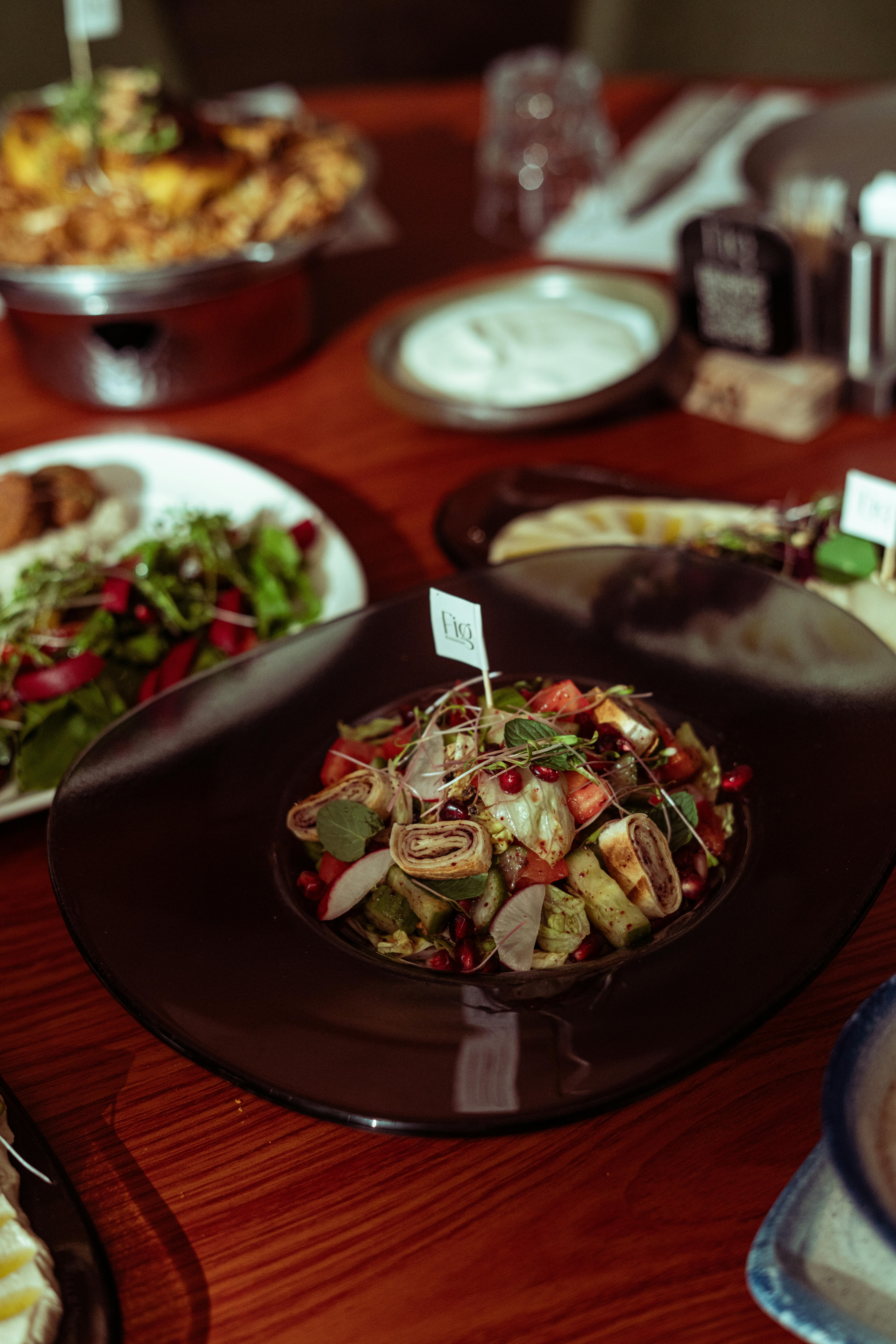
The menu is structured as a tasting experience, though with more flexibility than most tasting-menu restaurants allow. Dishes move through a sequence that references Levantine food traditions — the small plates, the breads, the grilled proteins, the shared end-of-meal sweets — but treats each reference point as a starting point rather than a finishing line. A mutabal course that deconstructs the dip into its component flavours and rebuilds it around a specific aubergine preparation. A kibbeh that does what kibbeh does but at a level of technique that the home version does not attempt. A dessert course that draws on Omar's training and produces, in Omar's words, "the ma'amoul you would make if you had ten more years and were not trying to scale it."
The cooking is confident. This is the thing that distinguishes it from the many restaurants, across the Gulf and beyond, that are attempting similar projects with Arab cuisine and producing food that reads as either too reverent or too showy. Orfali Bros has neither problem. The kitchen knows what its ingredients can do. The plating is restrained. The flavours, when they arrive, are exactly what the ingredients said they would be, intensified.
The room is smaller and more restrained than the ambition might suggest. Forty-odd seats, warm lighting, the kind of design that does not compete with the food. The service is excellent without being stiff. The wine list — building a wine programme in Dubai has its own specific challenges — leans on natural and biodynamic producers and is thoughtful within the constraints of operating in a market that does not have free access to European wine production.
What makes Orfali Bros specifically worth the flight, for a reader whose restaurant travel usually takes them to Paris and Tokyo and New York, is that the restaurant is doing something that those cities are not quite doing. The fine-dining treatment of Levantine cuisine is, globally, still at an early stage. Few restaurants anywhere are operating at Orfali Bros' level on these ingredients. The ones that are — and they are thin on the ground — are almost all in the Gulf region, and Orfali Bros is, by most credible measurements, currently the most technically advanced of them.
The broader point: Dubai's dining scene has, over the last five years, stopped being an import market and started being a generative one. Orfali Bros is the clearest proof, but it is not the only one. The restaurant has opened a door for local cuisine to be taken seriously at the highest levels, and the restaurants that have opened in its wake — the serious Emirati and Khaleeji kitchens, the younger Levantine chefs operating in Dubai's satellite dining rooms — are building on what Orfali Bros demonstrated was possible.
Who should eat here: anyone visiting Dubai who is serious about food and wants to understand what the city is actually capable of producing, as opposed to what it imports. Anyone curious about where Levantine cuisine goes next. Anyone who has eaten at the top-tier European and Japanese rooms and wants to see what the equivalent ambition looks like applied to ingredients from this side of the Mediterranean.
Book well in advance. Take the chef's menu with the pairing. Do not skip Omar's dessert course. Come back in two years and see what the brothers have moved on to.
The restaurant is going to matter for a long time. Get there before everyone else does.