Kazunori Hamana's vessels, and why to commission one
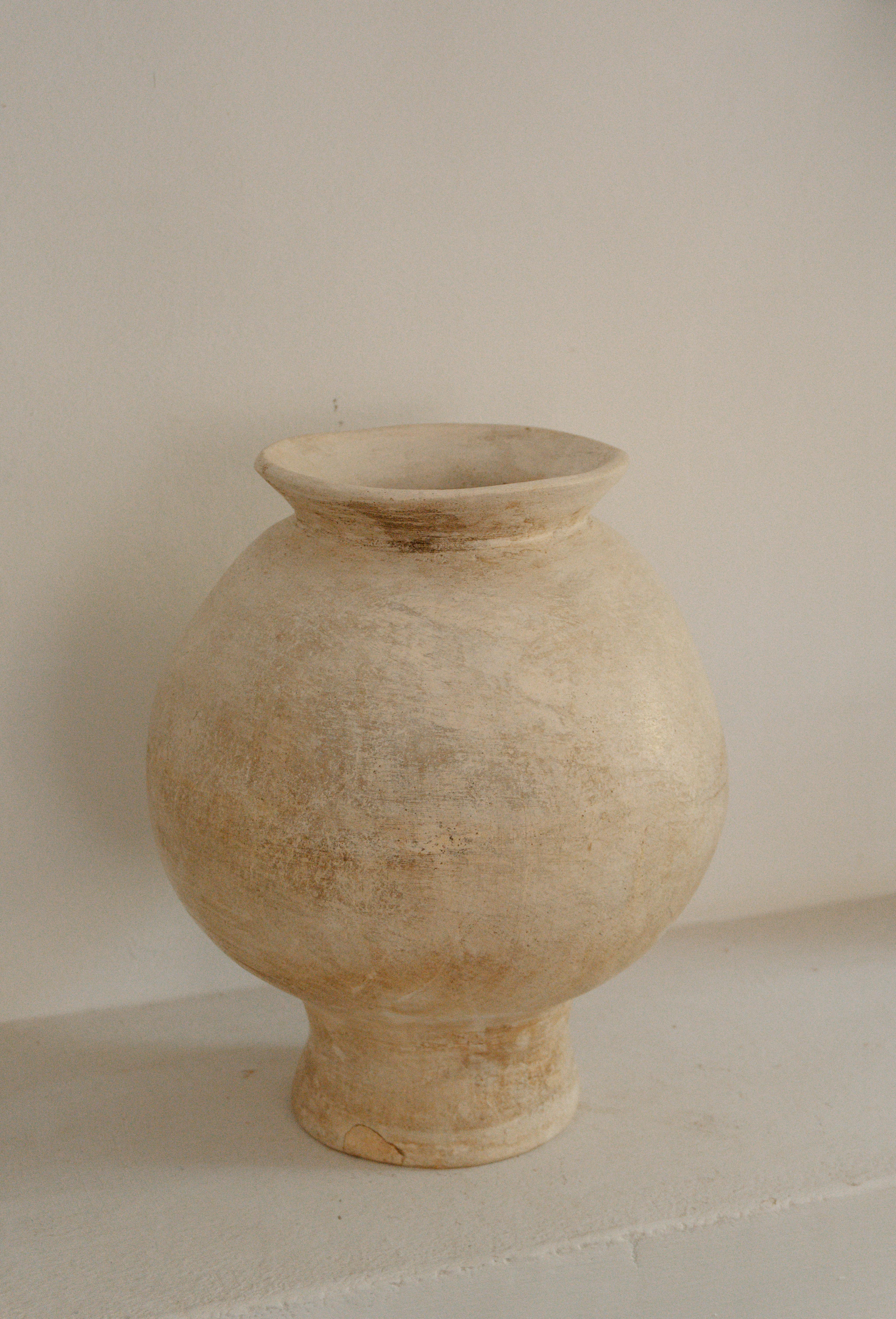
Wood-fired anagama ceramics from a village in Chiba, and the specific way commission works when the kiln is the maker.
Kazunori Hamana makes ceramics in a village in Chiba, roughly two hours from Tokyo by train, and his vessels are among the most collected contemporary Japanese ceramics currently in production. The work is represented by Blum & Poe in Los Angeles, Axel Vervoordt in Belgium, and a rotating list of serious ceramic galleries across Japan and Europe. The pieces sit in the permanent collections of multiple museums. The collectors, who include several well-known figures in contemporary design and art, have been acquiring the work steadily for most of the last fifteen years.
What the pieces look like, to describe them briefly: they are large ceramic vessels, usually stoneware, fired in the Japanese anagama tradition — wood-fired in a sloping kiln over a multi-day firing that produces natural ash glazes rather than applied ones. The forms are irregular but not wildly so. A Hamana vessel is, usually, a recognisable vessel — a jar, a vase, a large bowl — that has been allowed to deform during the making and firing in specific ways. The surfaces are the thing most collectors respond to: streaked, mottled, with the colour range produced by the ash and the flame doing their work across days rather than minutes.
Hamana himself came to ceramics obliquely. He trained in art and lived in Tokyo through his twenties; he moved to Chiba in his thirties and began building the studio and the kiln where he now works. The studio sits on agricultural land; Hamana keeps a vegetable garden, an orchard, and the kiln, and the working life of the studio is organised around the firing cycles, which are slow and expensive and happen several times a year rather than weekly.
The firing is the thing that makes the work expensive. A Hamana vessel is the product of a multi-day firing in which the kiln temperature is managed continuously, the wood has to be fed to the fire in specific patterns and quantities, and the vessels inside the kiln undergo a transformation that neither the maker nor the kiln operator can fully predict. The loss rate is substantial. The pieces that emerge from the kiln are the ones that have survived the process; the ones that do not are discarded or, sometimes, modified and re-fired. What ends up in a collector's home is the outcome of a long, uncertain process in which most of the decisions that affect the final piece are made by the kiln itself rather than by the maker.
This is the thing that interests collectors, and it is worth spending some time on. The Western tradition of collecting ceramics has, for most of its history, valued technical control. The Sèvres piece, the Meissen piece, the twentieth-century studio ceramics in the Bernard Leach tradition — all are admired for the extent to which the maker's intentions have been realised in the finished object. The Japanese tradition, particularly the tradition Hamana is working within, values something different: the extent to which the maker has created the conditions for the material and the fire to produce a specific kind of surface, and has then allowed the surface to happen.
Hamana's work exists in the specific zone where this Japanese valuation meets the contemporary Western collector's appetite for it. The pieces are expensive — a medium-sized vessel starts around ten thousand dollars and goes up into the six-figure range for the largest and most remarkable pieces — and the market has, over the last decade, only grown. The reasons for the growth are partly supply-constrained (Hamana fires a limited number of times per year, and the successful pieces from each firing are limited) and partly about the general appetite, in contemporary collecting, for work that reads as handmade in an era when machine-made objects dominate the visual environment.
Commissioning a piece, as opposed to buying one from the gallery inventory, is an unusual option but one that serious collectors do take. The commission does not work the way a Western commission works. The collector does not specify the piece. The collector, rather, engages with Hamana and his studio about the general proposition — a vessel of a certain size range, intended for a certain position in a home, with a preference for a certain kind of surface — and then commits to accepting whatever comes out of the firing. This is, in effect, a reservation of kiln space rather than a commission in the traditional sense. The vessel that arrives is the vessel that emerged. If the commissioned vessel does not satisfy, the collector has some recourse — the studio will sometimes substitute from the firing's other successful pieces — but the premise is that the collector is buying into the process as much as the object.
For the right collector this is the specific appeal. The object in the home is not quite the object the collector chose; it is the object the firing produced, and the collector's role was to make space for the firing to happen. This reverses the usual commercial logic around commissioned objects. It also, for collectors who have understood it, produces a different relationship with the resulting piece than a standard acquisition would.
The vessels, in a home, are usually placed alone. They are not objects that reward being grouped with other objects; a Hamana piece placed on a shelf next to other pottery tends to absorb the visual attention and render the surrounding objects inert. The Japanese convention is to place the vessel on a wooden stand or in a tokonoma alcove, singly, and to change the surrounding arrangement seasonally. The pieces reward this kind of attention. They also tolerate it; they are, despite their apparent fragility, extremely robust, and can be lived with for decades without developing the kind of accumulated damage that more delicate ceramics develop.
The broader point about Hamana's work, beyond its own value, is that it represents a specific current moment in the market for Japanese contemporary ceramics. The traditional Japanese ceramics that Western collectors were acquiring in the twentieth century — the Shoji Hamada pieces, the Kanjiro Kawai pieces, the various mid-century masters — are now historical, and their prices reflect that. Hamana, and a small number of his contemporaries, are producing work that is in that tradition but that is being made now, for now, by living makers whose studios can be visited and whose firings can be witnessed.
For the collector who wants a serious contemporary ceramic piece made in this tradition, by a maker at the full height of his current practice, Hamana is one of a handful of names worth knowing. The work is genuinely good. The price will be what it will be. The piece, once acquired, will change with the light across a day and will continue to be interesting, in the home, for as long as the home exists.
Most acquired objects do not meet this standard. The ones that do are worth the specific effort it takes to acquire them. A Hamana vessel is one of the ones that do.