Max Lamb's quarried-stone furniture, and the case for hand tools at scale
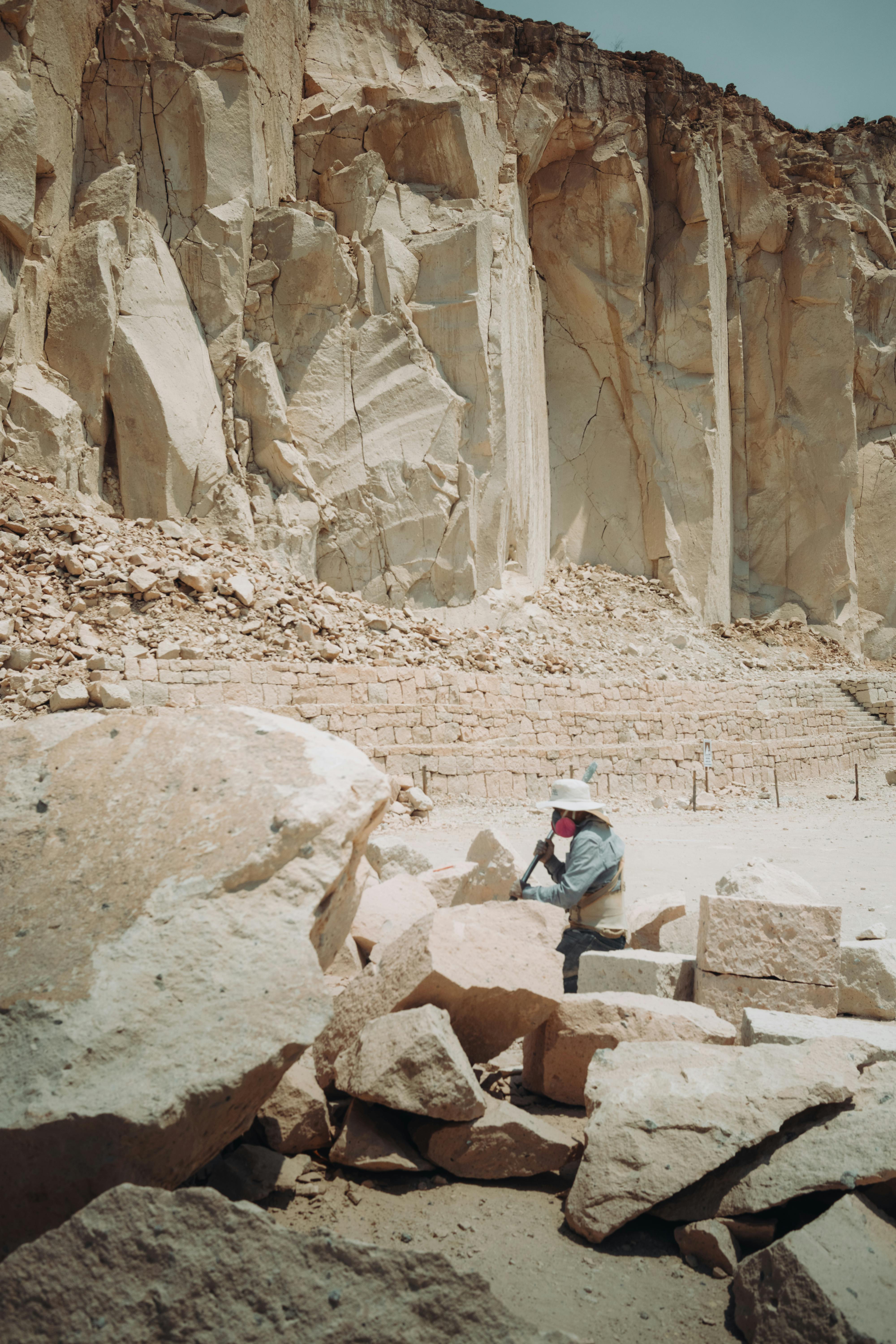
Fifteen years of working at quarries directly with splitters and chisels, and the specific middle-scale that turns out to work.
Max Lamb has been making furniture from quarried stone for most of fifteen years. The work is produced at various quarries across the UK, Italy, and Portugal, usually on location, using hand tools — chisels, splitters, grinders — and the resulting pieces are sold through Gallery Fumi in London, Salon 94 in New York, and a small list of other galleries that carry what is, in practice, a limited production of relatively expensive functional objects that sit between furniture and sculpture. Tables. Benches. The occasional chair. Objects that do what furniture is supposed to do, made from stone that was removed from a particular place, shaped by a particular process, and has a particular relationship to both.
Lamb is worth writing about because of what his practice demonstrates, not only about his own work but about a broader argument that is being made in contemporary design: that hand-tool production, at a specific scale and for specific objects, can produce work that is genuinely distinct from industrial alternatives in ways that justify the specific costs involved.
The practice: Lamb works at quarries directly, rather than having stone shipped to a workshop. He spends time — sometimes weeks, sometimes months — at a specific quarry, working with the quarry operators and the stone as it comes out of the ground. The pieces he makes are shaped at the quarry, using tools that quarry workers would recognise but that cabinet makers and sculptors typically would not have access to. A splitter, for example, is a specific kind of hand-operated tool used by quarry workers to split large blocks of stone along their natural fault lines; Lamb uses splitters to produce furniture-scale pieces with faces that show the stone's internal structure rather than the uniform surface that industrial cutting produces.
What this produces, in the finished pieces, is a specific quality of stone surface that industrial production does not produce. A table made by Lamb at a Welsh slate quarry has faces that show the slate's natural cleavage planes — the planes along which the stone naturally separates when hand-worked — rather than the uniform sawn surface that slate furniture typically has. The cleavage is rougher, more varied, and produces specific visual effects: the stone catches light differently across its surface depending on how the planes are oriented, and the piece, placed in a room, interacts with ambient light in ways that industrial stone furniture does not.
The pieces are also, by industrial standards, slightly irregular. A Lamb table is not perfectly flat on its top surface. It is flat enough to function as a table, but close inspection reveals small variations that reflect the hand-work process. This is the design decision. Lamb has been explicit in interviews that the irregularity is part of what the practice is producing, and that pieces which are too regular miss the point.
The broader argument the practice makes — and this is where Lamb's work becomes interesting beyond itself — is that a specific category of contemporary object is better made by hand than by machine, and that the economics of producing such objects by hand, while challenging, are not actually impossible at the scale his practice operates. Lamb is not producing one-off pieces for museum display. He is producing a steady output of functional furniture, priced in the range of ten to fifty thousand dollars per piece, which is expensive but is within the range of prices that serious collectors and residential designers will pay for high-quality work. The practice supports Lamb and a small team. It has been operating at this scale for about a decade.
The scale is the interesting number. Most defenses of hand-tool production in design press tend to focus on one-off pieces — a studio potter making a single vase, a cabinet maker making a single chair — and to concede that hand production cannot operate at what would conventionally be called a production scale. Lamb's practice suggests this is not quite right. It is true that his practice does not operate at industrial scale, and would not be economically viable if it tried to. But it operates at a specific middle scale — somewhere between the one-off studio piece and the industrial production run — that is often underweighted in design discourse. The middle scale allows for steady output, stable pricing, and a practice that can support itself as a business rather than as an art project.
What this middle scale enables, design-specifically, is the production of functional furniture that is actually used rather than displayed. A Lamb table goes into a dining room or a gallery or a museum, and it is used as a table. The pieces are durable enough — stone, after all, is durable — and are made to proportions that work for human use. They are not fragile, not ornamental, not treated as art objects by the owners who acquire them. They are furniture. The hand-production process is what distinguishes them, but the objects themselves are legitimate functional pieces.
This is, in some sense, the argument Lamb's practice is making against the contemporary design default, which has been to industrialise anything that can be industrialised and to reserve hand production for a narrow category of studio art. The default has produced, over the last several decades, a specific bifurcation in design output: mass-produced functional furniture on one side, hand-made art objects on the other, with relatively little in the middle. Lamb's work is in the middle, and the middle turns out to be a productive place.
The quarries themselves are the other half of what the practice demonstrates. Lamb works with quarries that are, in many cases, under commercial pressure — the small UK quarries producing stone for restoration work, the Portuguese marble quarries that have been overshadowed by larger Italian competitors. The pieces he makes are, among other things, a specific kind of advocacy for the quarries: the work demonstrates that the stone from a particular quarry has specific properties, and the resulting furniture supports, in a modest but real way, the continued operation of the quarry. A Lamb piece is labeled by origin — the specific quarry, the specific bed of stone — and the labelling is part of what is being sold.
For the buyer of one of these pieces, the ownership is different from the ownership of an industrially-produced object. The piece has a specific origin that is traceable. The hand-work process is visible in the finished piece. The object continues to reference the quarry and the process of its making for as long as it exists. This is a kind of value that industrial production does not produce and cannot reproduce.
The pieces will continue. Lamb's practice is not going anywhere. The quarries he works with, some of them, may or may not continue, and his relationship with them is partly a bet on their survival. The objects in the meantime are what they are: functional furniture made from stone that was removed from a specific place, by hand, at a specific scale that turns out to be viable.
Buy a piece if you can. Place it somewhere it will be used. Notice what the stone does across decades.