Moroccan tadelakt, and the three studios still making it the slow way
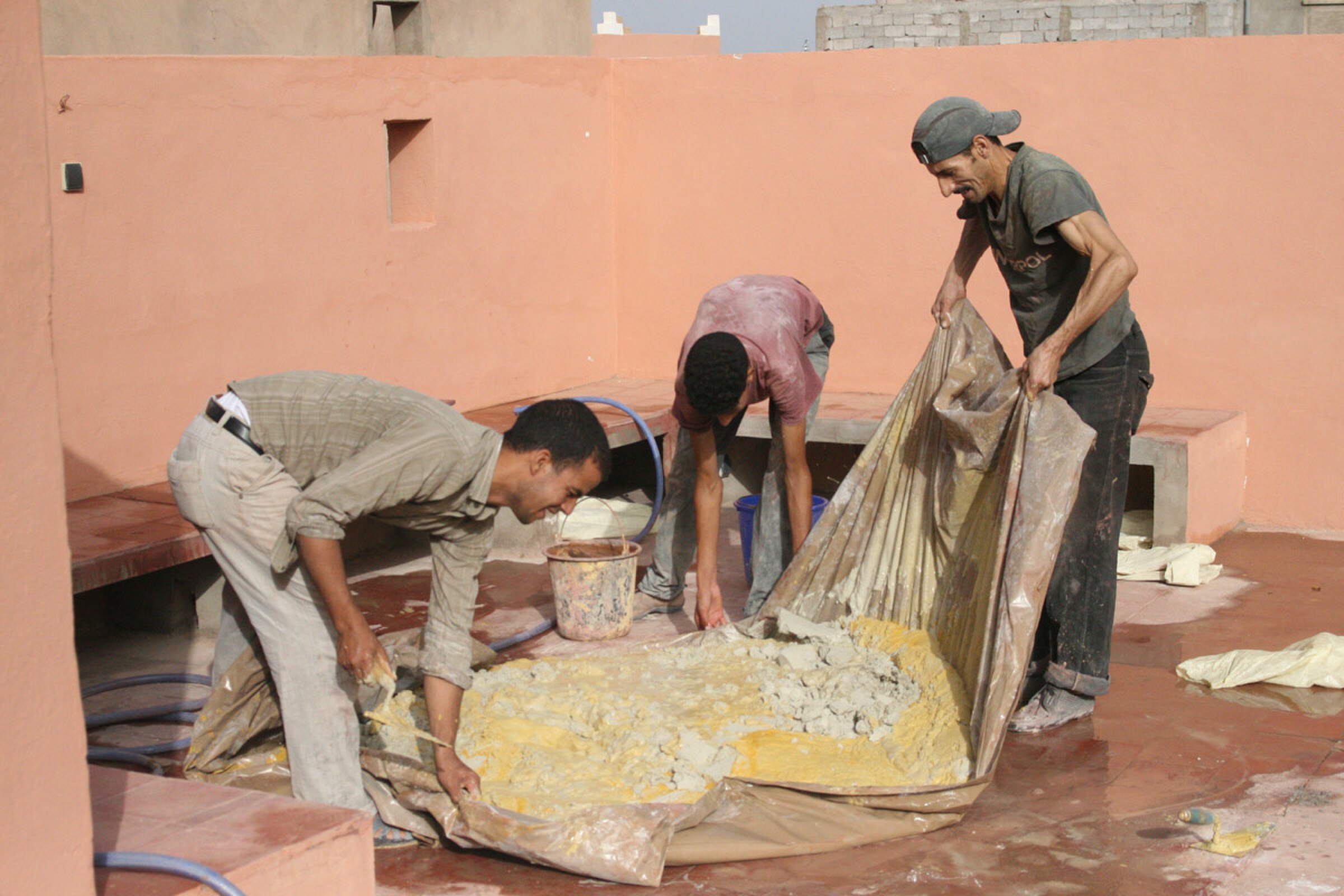
Lime, hammam-tradition substrate preparation, days of polishing — the difference between authentic tadelakt and the imitations that have taken its name.
Tadelakt is a Moroccan lime-based wall finish, traditionally used in hammams and courtyard walls in Fez, Marrakech, and the smaller cities of the Middle Atlas. The finish has a specific physical quality — a soft, slightly luminous surface, waterproof when properly executed, capable of holding rich pigments and of being polished to a near-marble sheen — that has made it, over the last twenty years, one of the more sought-after architectural finishes in contemporary high-end interior work. The Four Seasons, the Aman, various Soho Houses, and a long list of private residences commissioned by the kind of architects who have Six Senses on their speed-dial have specified tadelakt for bathrooms, steam rooms, and feature walls. The finish has, in other words, found a global market.
What has not scaled, and what is worth paying attention to, is the craft itself. Proper tadelakt — the kind that actually holds up for decades, that develops the particular surface quality that tadelakt is valued for, and that can be polished by hand to the degree the tradition specifies — requires a specific training that most of the plasterers currently executing tadelakt-style finishes around the world do not have. The finish that appears in hotel bathrooms across Asia and Europe, under the name tadelakt, is often a lime plaster with some of the surface treatments of the original but without the underlying substrate preparation, the specific mortar mix, or the hand-polishing sequence that the traditional craft requires. The result is a finish that looks, for the first year or two, like tadelakt, and that then begins to fail in specific ways that the traditional version does not fail.
The three studios that are still making tadelakt the traditional way — by which I mean using the specific lime, the specific aggregate ratios, and the full hand-polishing sequence that has been passed down through the Moroccan tadelakt tradition — are worth identifying specifically, because the work they do is genuinely different from the work being done in their name elsewhere.
The first is the atelier of Mustapha Blaoui in Marrakech. Blaoui is well-known in the design trade as a dealer in Moroccan antiques and objects, but the plastering atelier that operates alongside the dealership is the more significant part of the business from a craft perspective. The atelier employs a small number of master plasterers who have trained through the traditional Moroccan apprenticeship structure and who execute tadelakt commissions both locally and for international projects. The work is expensive — a small bathroom in authentic tadelakt from the Blaoui atelier runs into the tens of thousands of dollars, before shipping and installation — and is commissioned primarily by architects working on specific high-end residential and hospitality projects. The atelier has trained apprentices continuously for decades. The knowledge is being transferred.
The second is in Fez, at a compound near the medina run by a family of plasterers whose training goes back, by family account, four generations. The Fez tradition is slightly different from the Marrakech tradition — the specific mineral composition of the lime used is local, and the polishing techniques reflect the specific requirements of Fez's traditional courtyard architecture — and the atelier still executes tadelakt work for the restoration of historical buildings in the medina as well as for contemporary commissions. The family has been reluctant to scale, which is part of why the work continues to meet the traditional standard. They take on a specific number of projects per year and decline additional work.
The third is in the Ourika Valley outside Marrakech, at a smaller operation run by a plasterer who trained originally in the traditional system and now works primarily with contemporary architects on specific projects. This is the most internationally visible of the three studios — the plasterer in question has been featured in several design publications and has worked on projects in Europe and the US — and is the one most likely to be familiar to readers of design press. The output is small, the work is expensive, and the commissions are often for architects working on projects where the specific quality of traditional tadelakt is part of the design proposition.
What these three studios are maintaining, collectively, is the specific craft knowledge that tadelakt requires. This knowledge is not easily written down. It includes the specific preparation of the substrate (the plaster wall under the tadelakt must be prepared in a particular way, with a particular moisture content, before the tadelakt can be applied). It includes the specific mortar mix (lime, aggregate, pigment, in ratios that vary depending on the intended use and the specific conditions of the room). It includes the application technique (multiple layers, each polished before the next is applied, over a period of several days). And it includes the final polishing sequence (black soap, waxing, hand-polishing with a particular kind of stone, to produce the specific surface quality that finished tadelakt should have).
Each of these steps can be approximated by a trained plasterer without the specific Moroccan training. The result, done well, will look like tadelakt for a period. It will not perform like tadelakt, and it will not age like tadelakt, and eventually the difference will become apparent. The Blaoui atelier has been called in repeatedly over the last decade to repair tadelakt-style finishes in hotels and residences that were initially executed by non-traditional plasterers; the usual outcome of these inspections is that the original finish cannot be repaired and must be removed and replaced.
What this matters for, in practical terms, is specification. The architects and designers who specify tadelakt for a project have to decide whether they are specifying the traditional version — which requires engaging one of the small number of studios that can execute it — or whether they are specifying the contemporary imitation, which is what most plastering contractors will deliver. The cost differential is significant. The long-term quality differential is also significant. These are different products under the same name.
What it also matters for, in a more cultural sense, is the continued existence of the craft. The three studios identified here are not the only ones in Morocco capable of executing traditional tadelakt, but they are among the few that are actively doing so at international commissions. The apprenticeship structures they maintain are part of what is keeping the craft alive as a living practice rather than a historical one. International demand, channelled correctly, supports the craft; international demand channelled to faster and cheaper imitations weakens it, by crowding out the commissions that would otherwise go to the traditional studios.
For the reader who might commission tadelakt for a project: specify the studio. The finish can be extraordinary. The right specification ensures that the finish is actually what it is called, that the craft economy that produces it continues to have the work it needs, and that the resulting surface will perform the way the tradition says it will for the decades the tradition says it will last.
Most imitations do not last. The original, properly executed, does.