Northern Higashiyama, and why to go in November
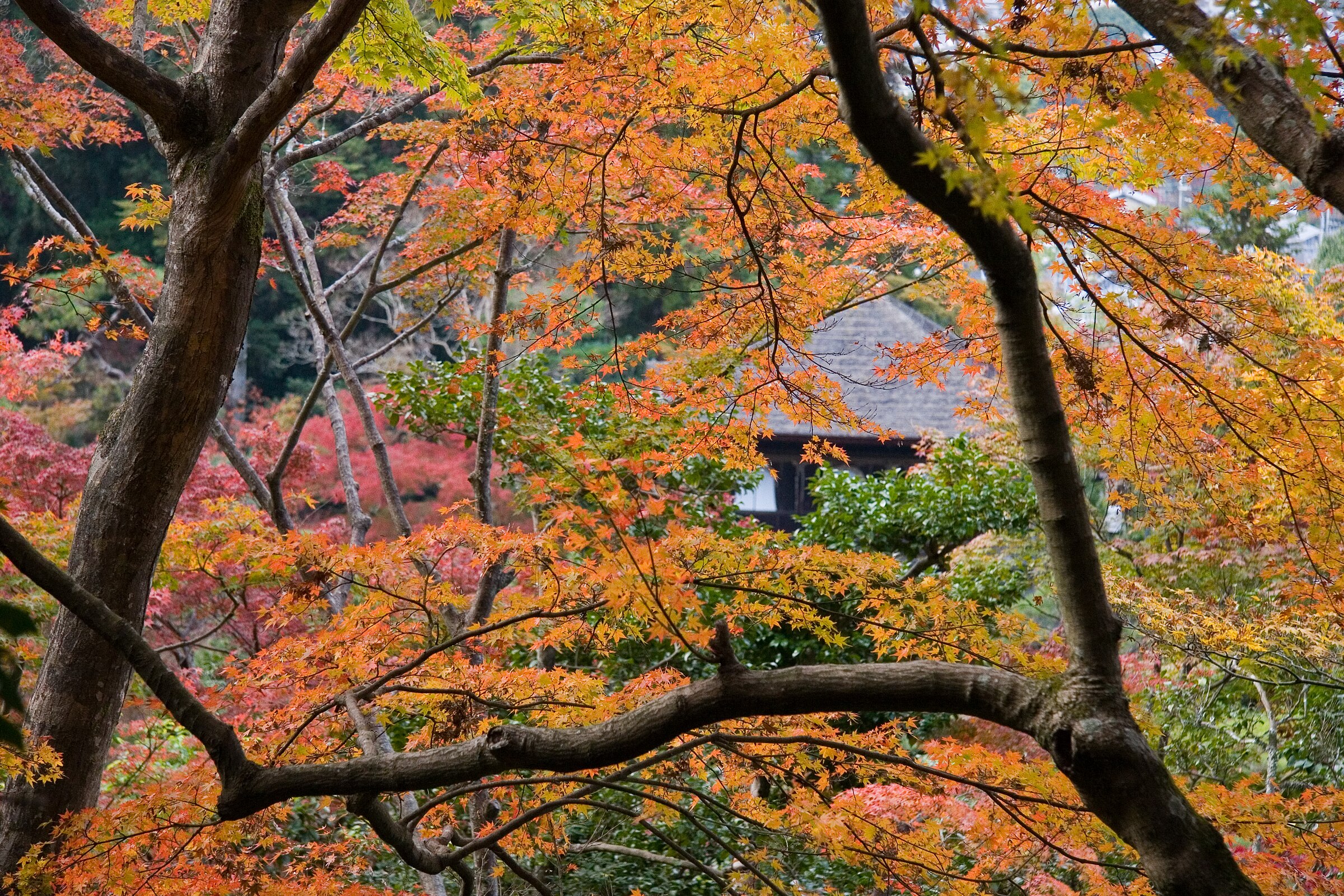
The eastern hills of Kyoto in the third week of the maple turn, walked from Ginkakuji to Nanzenji at dawn.
The thing about Kyoto in November is that everyone knows about it. The maple leaves turn, the temples open for evening illuminations, the Japanese domestic tourism industry produces its annual pilgrimage, and the Kodaiji and Eikando queues by late afternoon run out to the street. If you have read any travel writing about Kyoto, you have read about this. The solution that most writing proposes is to go in a different month. The better solution is to go in November and to go to Northern Higashiyama, which is the other side of the mountain from where the crowds are.
Northern Higashiyama runs along the eastern hills above the Philosopher's Path, from Ginkakuji in the north down to Nanzenji in the south. It is, by any reasonable measure, the most coherent concentration of important temples and gardens in Kyoto — Ginkakuji, Honen-in, Eikando, Nanzenji, the smaller sub-temples that fill the spaces between — and in November it is also, by some margin, the most beautiful stretch of landscape in urban Japan. The maples peak around the third week of the month, depending on the year. The dates shift. The trees know.
Go early. This is the rule for Kyoto generally and Northern Higashiyama specifically. Most of the temples open at 8am or 9am. The Japanese tour buses start arriving around 10am. The difference between an empty temple garden at 8.30am and the same garden at 11am is the difference between the experience as it was designed and the experience as it has been compromised by the tourism industry. The compromise is not the temples' fault. Go early anyway.
Start at Ginkakuji, the Silver Pavilion, which is at the northern end of the Path. Ginkakuji is the lesser-known counterpart to Kinkakuji, the Golden Pavilion on the other side of the city, and is the more interesting temple by most serious measurements — the pavilion is smaller and older and not actually silver (the silvering was planned and never executed, which turns out to have been the right decision), and the garden is one of the finest examples of the Japanese dry-landscape tradition. Walk it slowly. The raked sand cone in front of the pavilion is called the kōgetsudai and represents Mount Fuji. The moss garden beyond it is six hundred years old.
Walk south along the Philosopher's Path. The path follows a small canal for about two kilometres and is lined, in November, with maples and cherries (the cherries in spring being the other reason people come, but that is a different piece). At this time of year the path itself is the experience. Walk slowly. Pay attention to the water.
Honen-in is a minor temple that sits fifty metres off the Philosopher's Path and is, for the twenty minutes you spend inside its gate, the best ten minutes of most trips to Kyoto. The entrance is a thatched gate with two sand platforms on either side, raked by the monks in changing patterns through the year — in November, typically, maple leaf forms — and beyond the gate is a small garden and a temple that you can walk through in ten minutes and will want to spend an hour in. There is no queue. Most foreign tourists walk past the gate because it looks private. It is not private. Walk through.
Eikando is a temple that exists specifically for the autumn. It has over three thousand maple trees, it runs its evening illumination for three weeks in mid-to-late November, and it is the most beautiful temple in Kyoto at exactly one time of the year. Go in the afternoon, when the light is oblique and the leaves are backlit, rather than at the evening illumination, which is crowded and involves queueing. The afternoon requires patience but rewards it.
End at Nanzenji, which is the great Zen temple at the southern end of the district and which has, within its precincts, one of the strangest and most photogenic structures in Kyoto — the Suirokaku aqueduct, a nineteenth-century brick arched aqueduct that runs through the temple grounds and looks, improbably, like Roman architecture in the middle of a Japanese Buddhist complex. It is correct to find this jarring. It is also, against expectation, one of the finest photographic subjects in the city.
Lunch. This is where Northern Higashiyama falls short of being a complete proposition. The restaurants in the immediate area are either tourist-facing (avoid) or require reservations made weeks in advance (shōjin ryōri at Shigetsu inside Tenryuji, technically a different district but within striking distance; kaiseki at Hyotei, which is the three-Michelin-star option). The middle ground is limited. Eat at the Honen-in café, which is simple and good, or walk down to Okazaki and eat a soba lunch at Honke Owariya, which has been open since 1465.
Where to sleep: stay in central Kyoto, not in Higashiyama itself. The ryokan and machiya in the Gion and Pontocho areas are within walking distance or a short taxi from the Path, and sleeping in a district with restaurants and bars that are open in the evening makes a meaningful difference to the quality of the trip. Tawaraya for the classic ryokan experience, if you can get in. Hiiragiya for the alternative. Hotel Kanra for a more contemporary option that does not compromise on quality.
The larger point about Northern Higashiyama in November is that it is, for a brief period, what Kyoto is famous for being — a city of temples and gardens arranged in a way that the weather and the season have decided to complete. Most of the year, the gardens are beautiful and the temples are beautiful, but the effect is steady rather than acute. For three weeks in November the effect is acute. If you have never been to Kyoto, go then. If you have been, come back, and this time walk the Path from north to south instead of the tourist route from south to north.
The temples are the same. Everything else changes.