Vitra's Fire Station programme, thirty years on
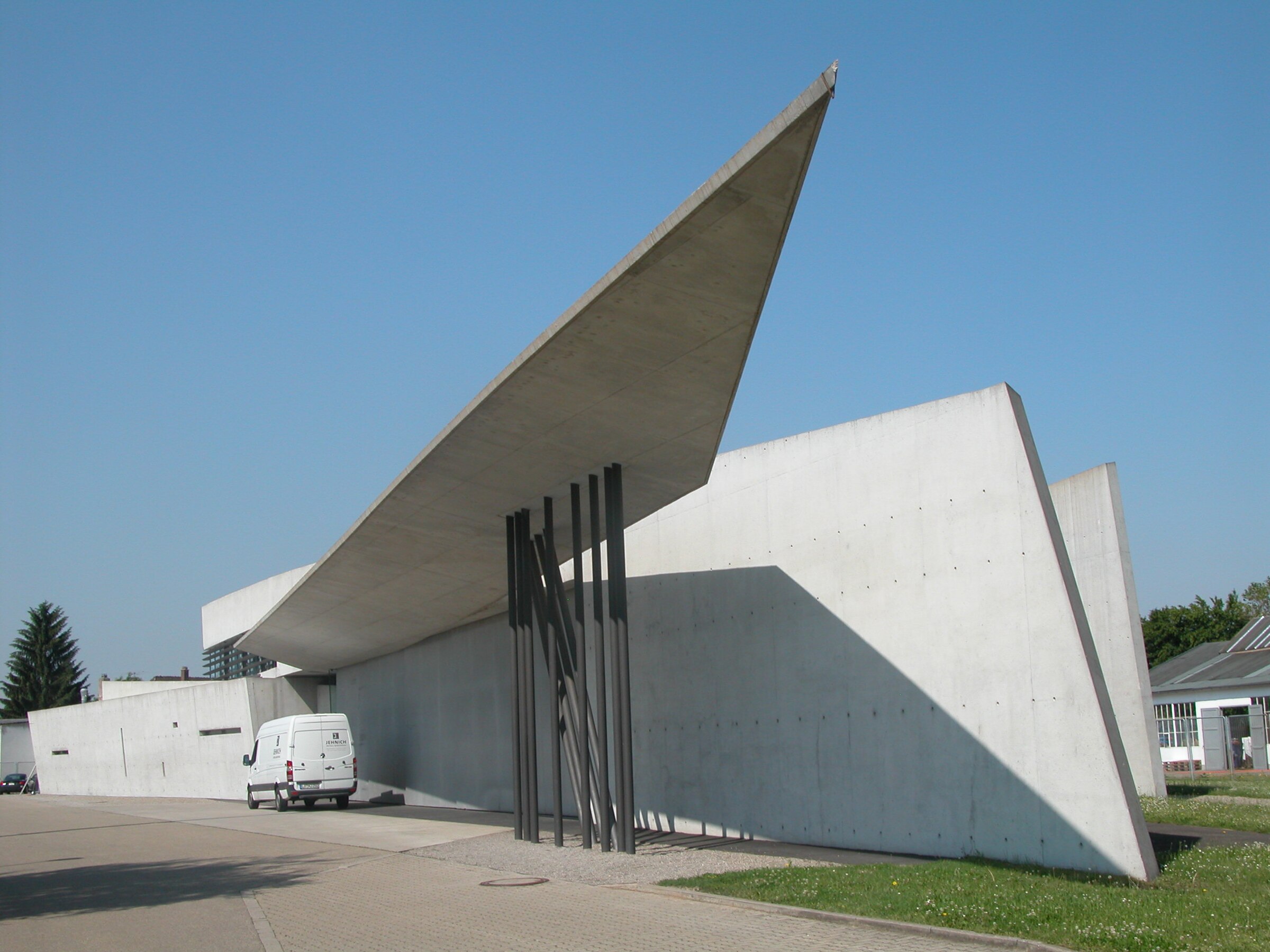
Zaha Hadid's first built work, the corporate campus it began, and the kind of patronage that produces when it works.
The Vitra Fire Station, completed in 1993 at the Vitra Campus in Weil am Rhein, was Zaha Hadid's first built work. The building was commissioned after a 1981 fire destroyed several of the factory's production halls, and the Fitzgeralds — the Dutch-German family that owns Vitra — had, following the reconstruction, decided to build a dedicated fire station on the campus to protect against further incidents. The fire brigade, accordingly, needed to be housed. Hadid, who had not yet built anything, was invited to submit a design. The resulting building was completed twelve years after her commission. Three years after the Fire Station opened, the factory's firefighting needs were reorganised and the fire brigade was disbanded. The building, which had been designed for a specific operational use, became immediately redundant.
This is where the Fire Station's second life begins, and it is the second life — the thirty years since the building ceased to function as a fire station — that is the subject most worth thinking about. Vitra did not demolish it, or convert it aggressively, or lease it to a commercial tenant. Instead, the company adapted the building for what it has since been: an exhibition space, an occasional event venue, a structural curiosity that visitors to the Vitra Campus walk through and consider, and a monument to the specific moment in architectural history when Hadid's work shifted from paper radicalism to actual construction.
The building itself is, even now, strange. The plan is angular, derived from Hadid's early paintings in which perspective and gravity were treated as negotiable. The walls lean. The roof cuts across the interior at angles that do not correspond to the floor plan. The materials are exposed concrete throughout, raw in the way that early-1990s concrete was allowed to be raw, without the later generation's softening treatments. Walking through the interior, thirty years later, is to encounter a built environment that still does not entirely resemble other built environments — the spaces feel as though they have been assembled from drawings that did not quite reconcile themselves with the physical realities of construction, and the building's continued existence is partly the record of that reconciliation.
What the Fire Station programme has become, at the Vitra Campus, is the organising logic of the whole site. The Campus, which now includes buildings by Frank Gehry, Tadao Ando, Herzog & de Meuron, Álvaro Siza, SANAA, and Hadid again (her more recent VitraHaus contribution), is structured around the idea that each building is a specific architectural statement by a significant working architect. The Fire Station was the first such building, and its completion established the model the Campus has followed since: Vitra commissions a working architect, the architect designs a building that the company actually uses in some functional capacity, and the building becomes part of an unfolding collection of built work that can be visited and studied.
The model has not been widely replicated. There are corporate campuses with architectural pretensions — Apple Park, the Googleplex, various European corporate headquarters — but none have followed the Vitra approach of commissioning multiple different architects to produce distinct buildings on a shared site, organised around a company's actual operational needs. This is partly a matter of scale (the Vitra Campus is not large, in corporate terms) and partly a matter of commercial logic (the Campus is a public destination, not just a facility). It is also a matter of patronage, which is the word that fits most cleanly what the Vitra family has been doing at Weil am Rhein for forty years.
The Fire Station's redundancy, from 1996 onward, is the interesting case for thinking about the programme. The building cost what it cost. It was designed for a specific purpose. The purpose evaporated within three years. At a normal corporate campus, this would have been a problem — a misallocation of capital, a building that needed to be repurposed or demolished. At Vitra, the redundancy became part of the asset. The building was, as built, already an architectural work worth preserving for its own sake. The firefighting function was what had occasioned its construction; the architectural function was what justified its continuation.
This kind of patronage — in which a corporate client builds something that, once built, exceeds the operational justification for its construction — is rarer now than it was in the 1980s and 1990s, when the Vitra Campus was being formed. Corporate governance has tightened. Architectural commissions are more often judged by narrower criteria. The willingness of a company's leadership to build a building partly because the building itself will be interesting, regardless of whether the operational case closes, is not widely present in the current corporate-real-estate environment.
What Vitra has done with the Fire Station over thirty years is to demonstrate, in effect, what this kind of patronage produces when it works. The Campus has become, by accumulation, one of the more significant collections of late-twentieth and early-twenty-first-century architecture anywhere in Europe. Visitors come to see the buildings. Designers and architects come to study the buildings. The Vitra brand — which is, at its core, a manufacturer of designer furniture — has accumulated, through the Campus, a cultural position that its product lines alone would not have achieved.
Thirty years after its completion, the Fire Station is the building on the Campus that remains the most obvious object of study. Hadid died in 2016. Her practice continues but has, in the last decade, become a much larger architectural enterprise than the one that produced the Fire Station. The Station itself is a specific record of what Hadid's work looked like at the transition between its theoretical and built phases, and the record is increasingly difficult to access elsewhere — the early Hadid buildings are few, some have been substantially modified, and the drawings, while preserved in various archives, do not communicate what the buildings themselves communicate in person.
The Station, in this sense, is a monument. Not a monument to Hadid as she is now remembered — as the designer of the large parametric projects that defined her late career — but to the earlier Hadid, who drew buildings that appeared impossible and then built one that was, in every sense, still possible, and still standing, thirty years on.
Visit the Campus. Walk through the Fire Station in the order the building was designed to be walked through. Notice what the walls do and what the roof does. The building is not, quite, like other buildings, and this is the reason it was built, and the reason it has been preserved, and the reason it remains worth thirty years of continued attention.